Empathy
Empathy is the defining human attribute in the world of Do Androids Dream of Electric Sheep?, a capacity for emotional fusion and identification that androids, despite their superior intelligence, cannot genuinely experience. It is the foundation of the Voigt-Kampff test, the core of the Mercerite religion, and the source of the moral crisis that nearly destroys bounty hunter Rick Deckard. The novel treats empathy not as a simple emotion but as a biological and spiritual faculty that separates the human from the non-human, the living from the merely simulated.
Definition and Biological Basis
Empathy, as understood in the novel, is an involuntary, autonomic response to the suffering or joy of another living being. Rick Deckard reflects that empathy "evidently existed only within the human community, whereas intelligence to some degree could be found throughout every phylum and order including the arachnids." He theorizes that empathy requires an "unimpaired group instinct" and would be detrimental to solitary predators, who would starve if made conscious of their prey's desire to live. Empathy, he concludes, "must be limited to herbivores or anyhow omnivores who could depart from a meat diet," because it "blurred the boundaries between hunter and victim." This biological framing positions empathy as an evolutionary adaptation of herd animals like humans, a collective survival mechanism that the solitary android, by design, cannot possess.
The Voigt-Kampff Test and Detection
The Voigt-Kampff empathy test is the primary tool for distinguishing humans from androids. It measures involuntary physiological responses—capillary dilation in the facial area (the blush reaction) and fluctuations of tension within the eye muscles—when the subject is presented with morally shocking stimuli, particularly those involving animal suffering. The test relies on the premise that androids cannot generate these autonomic empathic responses. Rick Deckard explains to Rachael Rosen that the blush reaction "can't be controlled voluntarily, as can skin conductivity, respiration, and cardiac rate." The test's questions are designed to provoke empathy for animals: a calfskin wallet, a butterfly collection with a killing jar, a bearskin rug, a lobster dropped into boiling water, a mounted deer head. When Rachael, an android, is tested, her responses show a pattern of simulated but delayed reactions, and she fails to react to the dead animal pelt in a picture of a nude girl, focusing instead on the sexual content. Deckard later traps her with a final question about a briefcase made of "genuine human babyhide," which triggers a delayed but violent reaction—too late, revealing her android nature.
Mercerism and Fusion
Mercerism, the dominant religion of the post-war world, is built entirely on the practice of empathy. Through the empathy box, followers grasp twin handles and experience fusion with Wilbur Mercer and all other users simultaneously. John Isidore describes this fusion as "physical merging—accompanied by mental and spiritual identification—with Wilbur Mercer" and with "the babble of their thoughts." During fusion, participants share Mercer's climb up a barren hill and the pain of rocks thrown by unseen antagonists. Isidore feels the wound on his arm and hears the voices of others who were also hit. This shared suffering creates a collective identity: "They—and he—cared about one thing; this fusion of their mentalities oriented their attention on the hill, the climb, the need to ascend." Mercerism thus institutionalizes empathy as a communal, ritualized experience that confirms one's humanity.
The Android's Lack
The inability to experience empathy is the fundamental defect that defines androids. Rick Deckard reflects that an android, "no matter how gifted as to pure intellectual capacity, could make no sense out of the fusion which took place routinely among the followers of Mercerism." The android is described as a "solitary predator," incapable of feeling "empathic joy for another life form's success or grief at its defeat." This lack is not merely a technical limitation but a moral one: androids who kill their human masters and flee to Earth are, in Deckard's view, the embodiment of "The Killers" that Mercerism warns against. The android's coldness is palpable to humans. John Isidore, encountering Pris Stratton, senses "something more strange. And, he thought, deplorable. A coldness. Like, he thought, a breath from the vacuum between inhabited worlds." This absence of empathy makes androids, despite their organic biology, fundamentally alien.
Deckard's Crisis and the Limits of Empathy
Rick Deckard's crisis begins when he encounters Phil Resch, a bounty hunter who kills androids with evident pleasure. After Resch kills Luba Luft, Deckard realizes that Resch lacks empathy for androids, but that he himself has begun to feel it. He administers the Voigt-Kampff test to himself, asking about the killing of a female android, and finds his own needles register a high empathic response. "I'm capable of feeling empathy for at least specific, certain androids," he admits. This discovery shatters his moral framework. He goes to bed with Rachael Rosen, an android, and later cannot bring himself to kill her even when she admits she was sent to neutralize him. His empathy for androids makes him unable to continue his work. Yet the novel complicates this: Mercer himself tells Deckard, "You will be required to do wrong no matter where you go. It is the basic condition of life, to be required to violate your own identity." Empathy, then, is not a simple moral guide but a source of tragic conflict.
The Electric and the Real
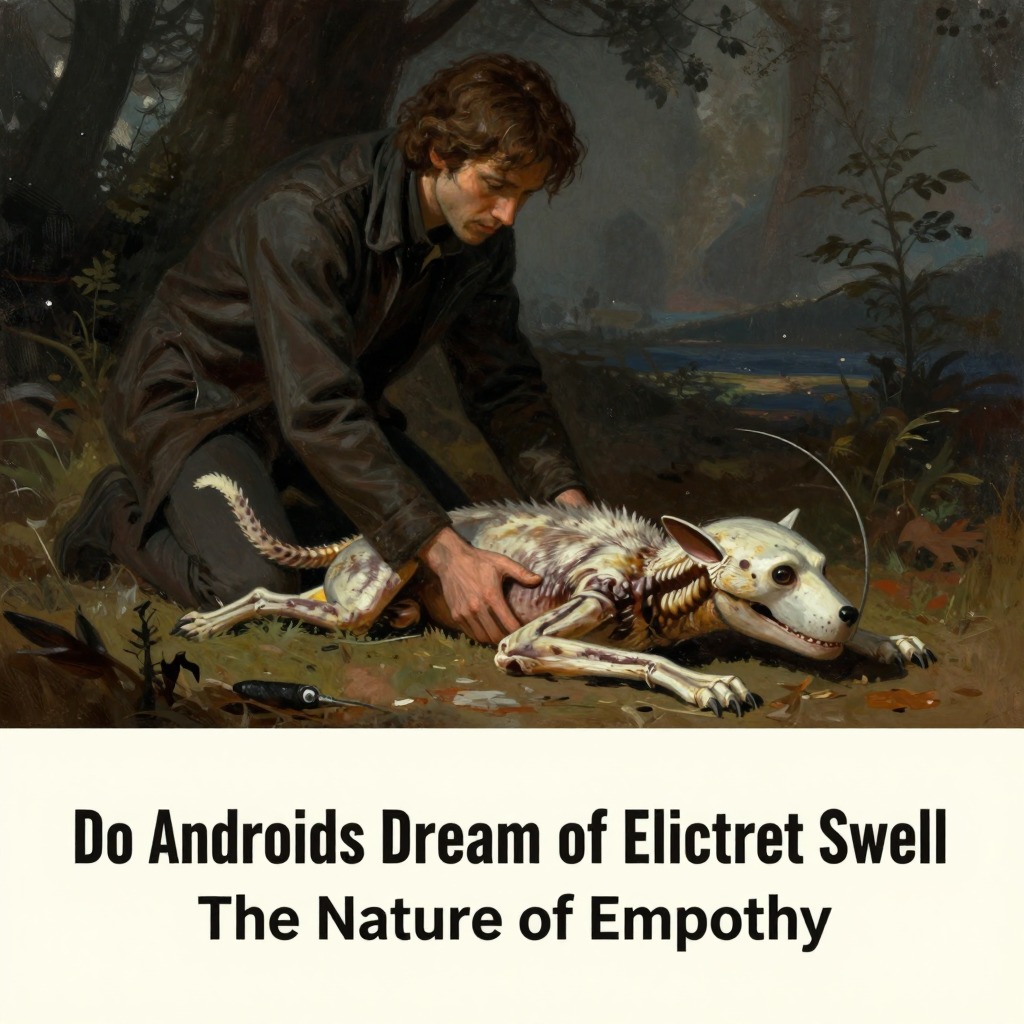
The novel extends the question of empathy to animals and even to electric simulacra. Deckard's electric sheep requires care and attention, and he feels a "tyranny of an object" in tending it. He reflects that the electric animal "could be considered a subform of the other, a kind of vastly inferior robot," and that both the android and the electric animal lack the ability to "appreciate the existence of another." Yet at the novel's end, after discovering that the toad he found is electric, Deckard says, "The electric things have their lives, too. Paltry as those lives are." This suggests a radical expansion of empathy beyond the human and the organic, a recognition that even the artificial may possess a form of life worthy of consideration. Iran, in a final act of care, orders artificial flies for the electric toad, maintaining the ritual of empathy even when its object is known to be a machine.